The Myth of “Async” Efficiency
In the software world, “Asynchronous Communication” (tickets, emails, Slack messages) is treated like a religion. The theory is that if you write everything down, you save time.
But we noticed a pattern. The “quick” ticket often turned into a slow disaster.
- The manager writes a ticket. It lacks context.
- The programmer builds the wrong thing.
- The tester finds a bug and logs it.
- The programmer can’t reproduce it.
- …and the cycle of re-work begins.
We call this “Ticket Pong.” It is a silent profit leak. You think you are being efficient because you typed a message in 30 seconds, but you actually triggered 3 days of confusion and re-work.
Our New Approach: The Synchronous Handoff
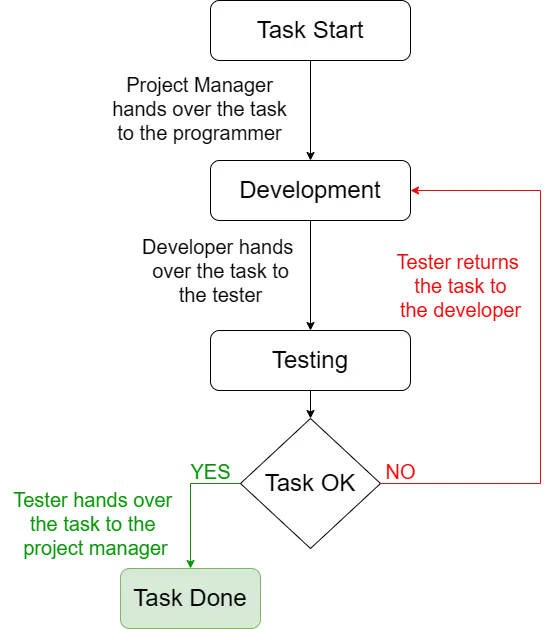
The Task Lifespan: The arrows represent the 3 critical moments where we enforce a conversation.
To plug this leak, we implemented a counter-intuitive rule: We force manual, high-context handoffs.
It looks like “wasted time” on the surface because it requires two people to stop and talk. But it is the most effective quality control measure we have.
The 3-Step Handoff Protocol
1
The Assignment Handoff (The “Why”)
The Old Way
Manager assigns a ticket in the system. Programmer reads it alone.
Our Approach
The Manager assigns the ticket, and then calls the programmer for a 5-minute briefing.
We discuss: “Here is the ticket. But here is the context—why the client needs this and what they are actually trying to achieve.”
The Result: The programmer understands the intent, not just the instructions. This prevents “technically correct but useless” features.
2
The Delivery Handoff (The “Show Me”)
The Old Way
Programmer moves ticket to “Ready.” Tester picks it up blindly.
Our Approach
The Programmer calls the Tester. “I finished the task. Let me show you what I built and how it works.”
The Result: The tester sees exactly what changed. They don’t waste time guessing how the feature is supposed to behave.
3
The Bug Handoff (The “Look at This”)
The Old Way
Tester logs “Bug #402: System crashes.” Programmer replies “Can’t reproduce.”
Our Approach
The Tester calls the Programmer. “Look at my screen. Watch me do this. See? It crashed.”
The Result: The programmer sees the bug instantly. No logs, no screenshots, no “works on my machine” excuses.
The “Deep Work” Caveat
You might be thinking: “Wait, didn’t you just tell us to ban interruptions in the Morning Shield article?”
Yes. This is the crucial distinction: Synchronous does not mean Unscheduled. We don’t just tap people on the shoulder. We schedule these handoffs. But when the handoff happens, we refuse to do it over text. We do it voice-to-voice or screen-to-screen.
The Takeaway
Efficiency isn’t about typing faster. It’s about understanding deeper. A 10-minute conversation can save 10 hours of debugging. Don’t be afraid to talk to your team. It’s the cheapest insurance policy you can buy.
Read Next in Protocols
The “Fair Queue” Script: How to Handle “Urgent” Client Requests Without Chaos
You can control your team, but what about angry clients calling at 10 AM? Here is the exact script we use to handle them.
The 15-Minute Morning Routine That Buys Us 8 Hours of Focus
Why we banned “quick questions” and replaced them with a culture of silence and respect.