Every company owner has done a SWOT analysis.
And for 90% of them, that analysis is currently gathering dust in a Google Drive folder.
Strengths were listed. Weaknesses were acknowledged. Opportunities were debated. Threats were feared.
Then everyone went back to work, and nothing actually changed.
The problem isn’t that agencies don’t know their weaknesses.
The problem is that they don’t turn them into decisions.
That’s because SWOT is passive by design. It gives you an inventory of problems and risks, but no mechanism to act on them. It encourages long discussions, colorful sticky notes, and eventually analysis paralysis. You end up aware of your issues, but still operating the same way you did before.
This is where the TOWS Matrix changes the conversation.
While SWOT describes your situation, TOWS forces action. It connects internal reality to external pressure. It makes you ask uncomfortable but necessary questions like:
– How do we use this strength to neutralize that threat?
– Which weakness is exposing us to the most financial risk right now?
TOWS turns insight into strategy. And for companies, that difference is often the fine line between leaking profit and protecting it.
SWOT vs. TOWS: What is the Difference?
At first glance, SWOT and TOWS look like the same tool with the letters rearranged. In practice, they serve two very different purposes.
SWOT is a snapshot.
It shows where your company is right now. Your strengths, your weaknesses, the opportunities you see, and the threats you fear. It’s descriptive and static. Useful for awareness, but limited when it comes to execution.
TOWS is a roadmap.
It shows where your company needs to go next. It is active by design. Instead of listing factors, it forces you to connect them and turn them into strategic moves.
The key difference is the direction of thinking.
With SWOT, most teams start internally. They talk about what they’re good at and where they struggle, then loosely acknowledge the market. The result is a clean document and very few decisions.
TOWS flips the logic.
You start with external reality first:
- What opportunities does the market create right now?
- What threats are putting pressure on your margins, pricing, or delivery?
Only after that do you look inward. You deliberately match those external forces to your internal strengths and weaknesses and ask a much harder question: “What must we do about this?“
That’s why TOWS is often described as “SWOT spelled backwards.” Not as a wordplay trick, but as a shift in mindset. External pressure comes first. Internal capability must respond.
For companies that want clarity, focus, and profit protection, that shift makes all the difference.
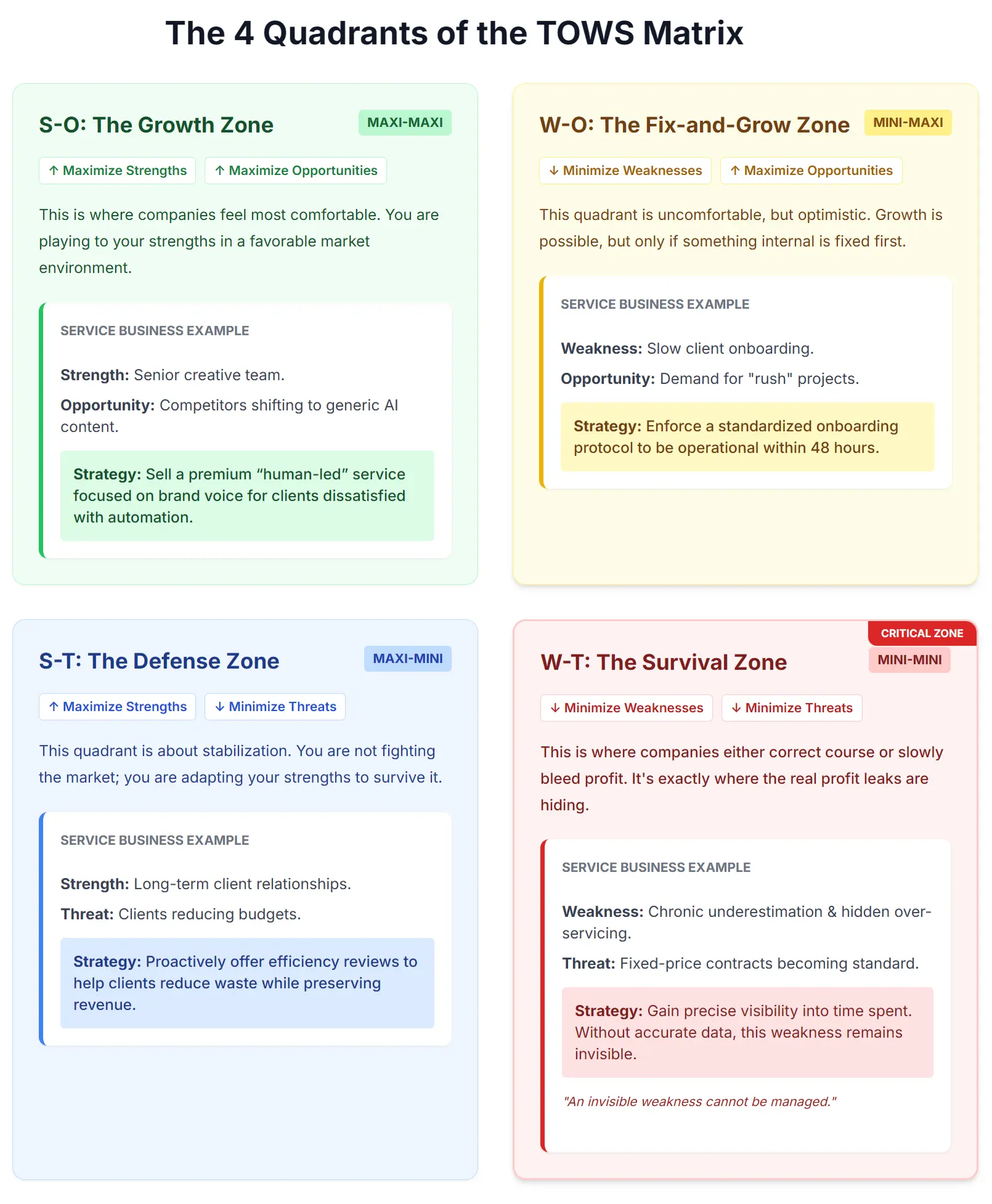
The 4 Quadrants of the TOWS Matrix (Service Business Edition)
The power of the TOWS Matrix lies in its four strategic quadrants. Unlike generic strategy frameworks, TOWS is most effective when it is grounded in the daily realities of service businesses: people, time, delivery, margins, and client expectations.
Strengths × Opportunities
S-O: The Growth Zone
Maxi-Maxi
↑ Maximize Strengths
↑ Maximize Opportunities
This is where companies feel most comfortable. You are playing to your strengths in a favorable market environment.
Service Business Example
- Strength: Senior creative team.
- Opportunity: Competitors shifting to generic AI content.
Strategy: Sell a premium “human-led” service focused on brand voice for clients dissatisfied with automation.
Weaknesses × Opportunities
W-O: The Fix-and-Grow Zone
Mini-Maxi
↓ Minimize Weaknesses
↑ Maximize Opportunities
This quadrant is uncomfortable, but optimistic. Growth is possible, but only if something internal is fixed first.
Service Business Example
- Weakness: Slow client onboarding.
- Opportunity: Demand for “rush” projects.
Strategy: Enforce a standardized onboarding protocol to be operational within 48 hours.
Strengths × Threats
S-T: The Defense Zone
Maxi-Mini
↑ Maximize Strengths
↓ Minimize Threats
This quadrant is about stabilization. You are not fighting the market; you are adapting your strengths to survive it.
Service Business Example
- Strength: Long-term client relationships.
- Threat: Clients reducing budgets.
Strategy: Proactively offer efficiency reviews to help clients reduce waste while preserving revenue.
Weaknesses × Threats
W-T: The Survival Zone
Mini-Mini
↓ Minimize Weaknesses
↓ Minimize Threats
This is where companies either correct course or slowly bleed profit. It’s exactly where the real profit leaks are hiding.
This isn’t just an operational annoyance; it’s expensive. Data from the Project Management Institute suggests that companies waste nearly 12% of their investment due to poor strategic alignment.
Service Business Example
- Weakness: Chronic underestimation & hidden over-servicing.
- Threat: Fixed-price contracts becoming standard.
Strategy: Gain precise visibility into time spent. Without accurate data, this weakness remains invisible.
“An invisible weakness cannot be managed.”
A Real-World TOWS Matrix Example
To see how the TOWS Matrix works in practice, let’s walk through a simple, realistic example using a fictional digital services company called CreativeFlow.
The Analysis
In a TOWS analysis, we deliberately start with external pressure before looking at internal capability.
External Threats (T)
- Economic downturn squeezing marketing budgets
- Freelancers and low-cost providers undercutting prices
External Opportunities (O)
- Growing demand for AI implementation services
- Clients prefer predictable, retainer-based engagements
Internal Weaknesses (W)
- Inaccurate billing (poor visibility into work)
- High levels of scope creep during delivery
Internal Strengths (S)
- Highly skilled dev team (complex tech capability)
- Strong portfolio with proven results
The Strategies
S-O Strategy
Growth
Use the development team (S1) to build AI-based solutions (O1).
CreativeFlow leverages its technical depth to move into higher-value AI services, where demand is growing and competition is thinner.
W-O Strategy
Fix-to-Grow
Fix inaccurate billing (W1) to offer profitable retainers (O2).
Predictable pricing only works when you understand real costs. Without fixing billing accuracy, retainers become a financial risk instead of a growth lever.
S-T Strategy
Defense
Use the portfolio (S2) to justify premium pricing (T2).
Instead of competing on price, CreativeFlow competes on credibility and outcomes, protecting margins in a crowded market.
W-T Strategy: The Survival Move
Stop scope creep (W2) to survive an economic downturn (T1).
When budgets tighten, uncontrolled extra work quietly destroys profit. This is where precise time tracking and clear visibility into how work expands beyond what was sold become non-negotiable. You cannot protect margins during a downturn if you don’t know where your time is actually going.
This is the point where tools like PlanArty belong in the conversation. Not to “optimize productivity,” but to expose the operational truth required to fix the weakness that puts the company at risk.
How to Run a TOWS Workshop with Your Team
A TOWS workshop is not a brainstorming exercise. It is a decision-making session. The goal is not to generate ideas, but to leave the room with a short list of actions that protect or increase profit.
Here’s how to run it without wasting time.
1
Step 1: Do the SWOT (Fast)
Start with a basic SWOT analysis, but keep it intentionally short.
This is input gathering, not the main event.
If you spend three hours debating whether something is a “weakness” or a “threat,” you are already off track. The value of TOWS does not come from perfect categorization. It comes from what you do with the information next.
2
Step 2: Create the “Collision”
This is where TOWS actually begins.
Take the items from your SWOT and deliberately force them to collide:
- Does this strength genuinely help us capture that opportunity?
- Does this weakness expose us to that threat?
- If this threat worsens next quarter, what breaks first inside the company?
These questions remove abstraction. They turn vague observations into strategic pressure points.
3
Step 3: Select What Matters
By the end of this exercise, you will easily generate 15–20 possible strategies.
Most of them should be discarded.
Pick the top three actions that have the highest impact on profit and risk reduction.
This step is not consensus-driven. It is leadership-driven. Comfort and fairness are irrelevant here. Profit impact decides.
When done correctly, a TOWS workshop does not end with sticky notes or a shared document. It ends with clear ownership, clear priorities, and fewer excuses for inaction.
A Simple TOWS Workshop Example
Imagine a 10-person digital services company running a 90-minute TOWS workshop.
Step 1: Fast SWOT (20 minutes)
The team quickly agrees on the following points:
- Strength: Senior developers who understand complex client systems
- Weakness: Projects regularly run over budget without anyone noticing early
- Opportunity: Growing demand for ongoing support and retainer contracts
- Threat: Clients are pushing back on price increases
Step 2: The Collision (30 minutes)
The team starts connecting the dots:
- Does our technical strength actually help us sell retainers? Yes, but only if we trust our cost structure.
- Does our weak cost visibility make price resistance more dangerous? Absolutely.
- If price pressure increases next quarter, what breaks first? Fixed-price projects with hidden overwork.
At this point, the discussion stops being theoretical. The risk becomes specific.
Step 3: Selection (Decision Time)
Several ideas emerge: new pricing packages, tighter contracts, scope training, better reporting.
Leadership makes a call.
The top three actions selected are:
- Gain precise visibility into how time is spent across projects.
- Use that data to recalibrate pricing for retainers.
- Set clear scope boundaries based on real delivery patterns.
These are chosen not because they are popular, but because they directly protect profit.
Why Most Companies Fail at TOWS
Most companies don’t fail at TOWS because the framework is complicated. They fail because they refuse to use it the way it was intended.
The first mistake is treating TOWS like a brainstorming session. Ideas are generated, everyone contributes, and nothing is filtered. When every strategy feels equally valid, no strategy gets executed.
The second mistake is avoiding the W–T quadrant entirely. This is the uncomfortable zone where weaknesses meet real external pressure. It forces companies to admit where they are exposed, inefficient, or blind. Many teams subconsciously skip it and focus on growth narratives instead. That avoidance is expensive.
There’s also a leadership failure hidden here. TOWS is often run as a consensus exercise, when it should be a decision exercise. Hard choices are softened to protect team harmony, and profit-impacting actions are delayed because they feel disruptive.
Ignoring the W–T quadrant is how companies bleed profit quietly.
No crisis. No collapse. Just margins slowly eroding while everyone agrees they “should fix it someday.”
Used correctly, TOWS is not comfortable. It is clarifying. And clarity is exactly what most companies are missing.
Conclusion: From Sticky Notes to Billable Hours
A strategy written on a whiteboard or buried in a shared document has no value on its own.
A strategy that changes how work is delivered, measured, and priced is what actually pays the bills.
The TOWS Matrix is effective because it refuses to stay theoretical. It forces companies to move from awareness to action, from observation to decision. It exposes where strengths can be leveraged, where growth is blocked, and most importantly, where weaknesses collide with real-world threats.
If you do one thing after reading this, start with your W–T quadrant. Identify the single weakness that exposes your company to the greatest risk. For many service businesses, that weakness is not effort or talent, but visibility. Not knowing where time goes. Not seeing where work expands beyond what was sold. Not catching profit leaks early enough to stop them.If your weakness is knowing exactly where your profit goes, it’s time to stop guessing.
Ready to See Your Business More Clearly?
If your weakness is knowing exactly where your profit goes, it’s time to stop guessing.
Discover how PlanArty gives you that visibility
No credit card required • Cancel anytime